Apostille for FBI Background Check Guide
Legalization, Apostille, FBI Background Check
Apostille for FBI Background Check: A Complete Guide for Individuals
If you are planning to work, study, immigrate, or get married abroad, you may be asked for an FBI background check with an apostille. This document proves your criminal record status in the United States and confirms its authenticity for use in another country. In this guide, we break down the process in clear, practical steps so individual applicants know exactly what to expect and how to avoid delays.

Get Your FBI Background Check Apostilled with Confidence
Step‑by‑step guidance for individuals planning to live, work, or study abroad
What Is an Apostille and Why Is It Needed for an FBI Background Check?
An apostille is a special certificate that verifies the authenticity of a public document so it can be legally recognized in another country that is part of the Hague Apostille Convention. For an FBI background check, the apostille confirms that:
The document was issued by the Federal Bureau of Investigation (FBI)
The signature and seal on the background check are genuine
It can be accepted by authorities in a foreign country without further legalization
Countries often require an apostilled FBI background check for visas, work permits, residency, adoptions, teaching positions, and even long‑term study programs. If you skip the apostille step when it is required, your application abroad may be rejected or significantly delayed.
Step 1: Requesting Your FBI Background Check as an Individual
Before you can obtain an apostille, you must first secure your FBI Identity History Summary, commonly referred to as an FBI background check. This is a nationwide report based on your fingerprints, not just a state or local record. As an individual, you can request it in two main ways:
Directly from the FBI through the official FBI website, where you submit an online application, pay the fee, and mail your fingerprints; or
Through an FBI‑approved channeler, a private company authorized to collect your information, submit it electronically, and return results more quickly.
When requesting your background check, pay attention to:
Processing time – Direct FBI requests can take several weeks, while channelers may return results in days.
Format of the result – For apostille purposes, you typically need an original paper copy of your FBI report, not just a PDF.
💡 Pro Tip: When you submit your request, confirm whether you can receive both an electronic copy for your records and a printed original for the apostille. This can save time if your first copy is lost or damaged.
Step 2: Who Issues the Apostille for an FBI Background Check?
Because the FBI is a federal agency, the apostille for an FBI background check is not handled by your state. Instead, it is issued by the U.S. Department of State – Office of Authentications in Washington, D.C. This is an important distinction for individuals, as sending your FBI report to a state authority will not produce a valid apostille for use abroad.
In practice, this means your process has two stages:
Obtain the original FBI background check.
Submit that original document to the U.S. Department of State (directly or via a service) for the apostille.
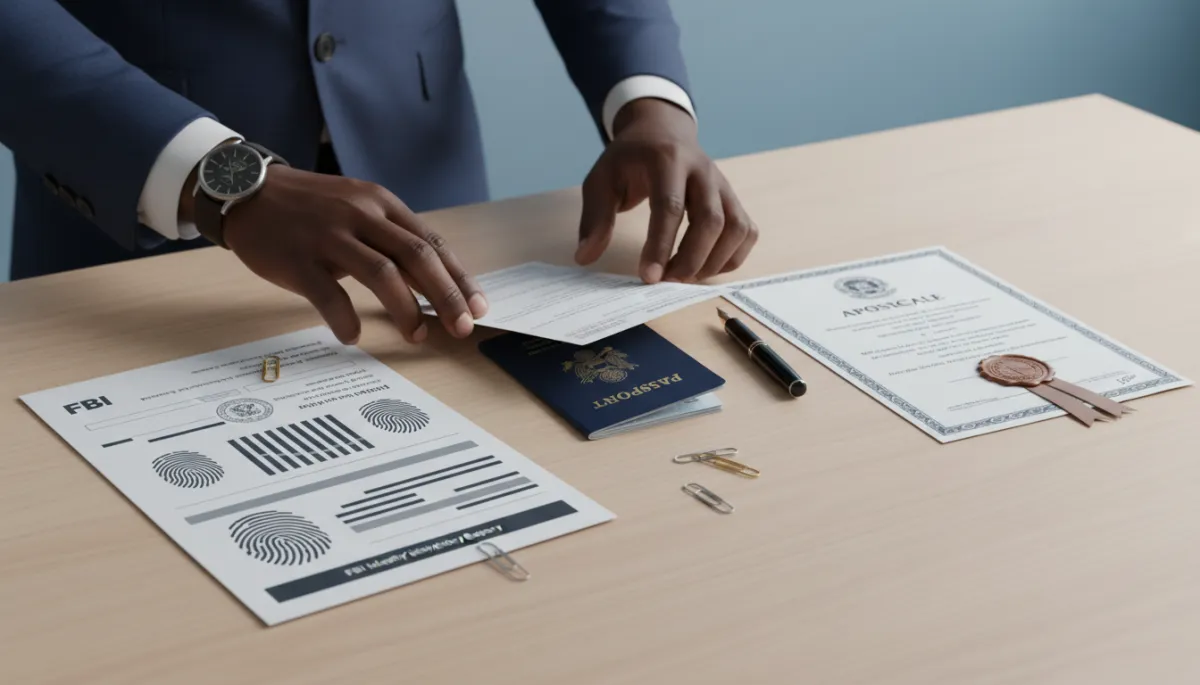
Preparing your FBI report and apostille together helps avoid last‑minute visa delays.
Step 3: How to Submit Your FBI Background Check for Apostille
Once you have the original FBI background check in hand, you can request the apostille. Individuals generally have two options:
Option A: Apply Directly to the U.S. Department of State
You can mail your documents yourself to the Office of Authentications. The typical package includes:
The original FBI background check (not a photocopy)
A completed request form from the Department of State website
The required government fee, usually paid by check or money order
A self‑addressed return envelope with tracking so your documents can be mailed back to you
Processing times vary depending on workload and whether you are inside or outside the United States. It is wise to check the current estimated timeline on the official website and build in extra time before your visa or relocation deadline.
Option B: Use a Professional Apostille Service
Many individuals choose to work with a specialized apostille agency. These companies handle the paperwork, submit documents on your behalf, and monitor the process. While there is an additional service fee, the benefits often include:
Guidance on exactly what the foreign country requires and in what format
Fewer mistakes in forms and payments that could cause rejections or delays
Faster processing in many cases, thanks to experience and dedicated staff
📌 Key Takeaway: If you are on a tight timeline or currently living abroad, using a professional apostille service for your FBI background check can save you both time and stress.
Special Considerations for Individuals Using Their FBI Apostille Abroad
Every individual’s situation is slightly different, and foreign authorities may have specific rules. Before you start, confirm the exact requirements with the consulate, embassy, or organization requesting your background check. Key points to clarify include:
Validity period – Many countries accept FBI background checks only if they were issued within the last 3–6 months. If your process takes too long, you may need a fresh report and a new apostille.
Original vs. copies – Some authorities insist on seeing the original apostilled document, not a scan or certified copy. Plan to keep it safe during travel.
Translations – If the country’s official language is not English, you may need a certified translation of both the FBI report and the apostille. Ask whether the translation must be done locally or can be prepared in the U.S.
Common Mistakes Individuals Make—and How to Avoid Them
Because the process involves multiple offices and strict rules, it is easy to make small errors that create big delays. Here are some of the most frequent issues individuals encounter when seeking an apostille for an FBI background check:
Sending a state background check instead of an FBI report. Many foreign authorities specifically require a federal FBI check, not a state police clearance. Always read the instructions carefully.
Requesting an apostille from the wrong office. State secretaries of state cannot apostille an FBI report; only the U.S. Department of State can do that.
Submitting photocopies. Photocopies of the FBI background check are usually not acceptable for apostille. You must send the original document with the official signature or seal.
Ignoring timelines. Waiting until just before a visa appointment to start the process can be risky. Postal delays, backlogs, or small form errors can push you past your deadline.
⚠️ Warning: Never alter, staple, or laminate your FBI background check or apostille. Modifying official documents can make them invalid and force you to start over.
Practical Timeline and Planning Tips for Individuals
To keep your plans on track, it helps to map out a realistic schedule. While exact times vary, many individuals find the following timeline helpful:
Week 1–2: Gather identification, complete fingerprinting, and submit your FBI background check request.
Week 2–6: Wait for the FBI report to be processed and delivered (faster if using a channeler).
Week 6–10: Send the original FBI report for apostille and wait for its return from the Department of State or a service provider.
Building in a two‑ to three‑month buffer before your intended departure date gives you room to resolve unexpected issues, such as lost mail, incomplete forms, or updated requirements from the foreign authority.
Final Thoughts: Taking Control of Your Apostille Process
Securing an apostille for your FBI background check may feel technical at first, but as an individual, you can manage the process smoothly with the right information and a bit of planning. Start by confirming exactly what the foreign country requires, then work backward:
Request the correct type of background check from the FBI.
Decide whether to apply directly for the apostille or use a professional service.
Allow enough time for mailing, processing, and any translations you may need.
With these steps in mind, your apostilled FBI background check becomes a straightforward part of your international plans rather than a last‑minute obstacle. Whether you are accepting a new job overseas, joining a study program, or applying for long‑term residency, handling this document early can give you peace of mind and keep your transition abroad as smooth as possible.