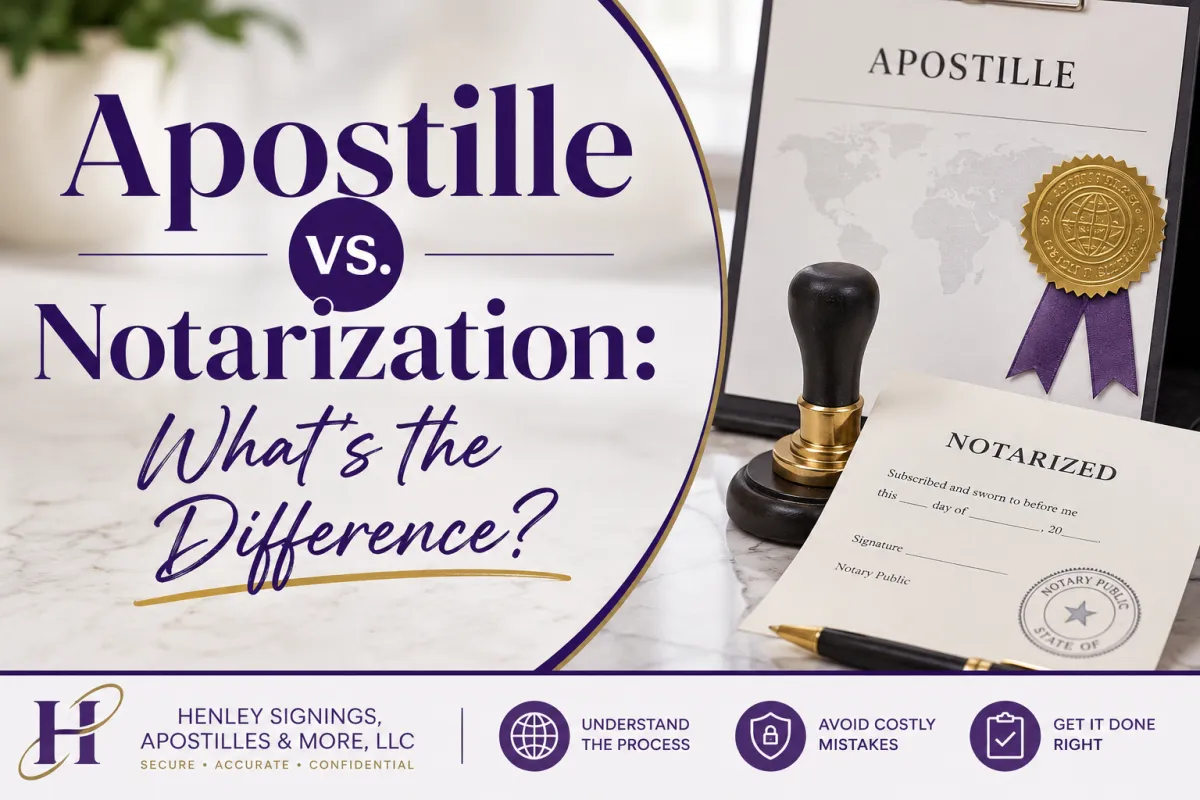
Apostille vs. Notarization: Key Differences Explained
Apostille, Notarization, International Documents, Florida Apostille
Apostille vs. Notarization: What’s the Difference?
Your document is signed, stamped, and ready to go—until someone tells you it also needs an apostille. Suddenly, you’re searching government websites, juggling deadlines, and wondering whether you’re about to mail the wrong thing overseas. Henley Signings, Apostilles and More, LLC understands how high the stakes can feel when immigration, school, business, or family plans depend on getting this right. This guide breaks down notarization and apostilles in clear, practical terms so you know exactly which one you need, when you might need both, and how to protect your time, privacy, and important records. For a step‑by‑step walkthrough of the Florida process, see our guide on how to get a Florida apostille.
Apostille vs. Notarization, Made Clear
Confidential, accurate, and convenient document support for international use
What Is Notarization?
Notarization is a formal process performed by a commissioned notary public. The notary’s role is to verify the identity of the signer, witness the signature, and confirm that the signer appears willing and aware. The notary then completes a notarial certificate and applies an official stamp or seal. This helps deter fraud and adds credibility to the document within the same country or state. If you’re specifically looking for mobile support, you may also want to read our post on mobile notary services in Florida.
📌 Real‑World Example – Local Power of Attorney: A Jacksonville resident needed to grant her sister authority to sell a car while she was working overseas. The document itself was simple, but the buyer’s bank in Florida refused to accept it until the signature was properly notarized. Once a Florida notary verified her identity, witnessed the signing, and applied a complete notarial certificate and seal, the bank processed the sale without further delay.
Commonly notarized documents include powers of attorney, affidavits, parental consent letters for travel, real estate documents, and certain business agreements. Notarization alone, however, usually is not enough when the document will be used outside the United States. For international travel with children, see our detailed article on notarized consent letters for a minor’s travel.
What Is an Apostille?
An apostille is a special certificate issued by a government “Competent Authority” that authenticates the origin of a public document for use in another country that is part of the Hague Apostille Convention of 1961 (often called a “Hague country”). In the United States, each state designates its own authority; in Florida, that authority is the Florida Secretary of State for state-level documents, while certain federal documents are authenticated by the U.S. Department of State in Washington, D.C. (NASS; dos.fl.gov). For a deeper dive into country‑specific rules, visit our overview of apostille requirements by destination country.
The apostille does not validate the content of your document. Instead, it confirms the authenticity of the signature, seal, or stamp on that document so that authorities in another Hague member country can trust it without additional legalization steps (NASS, What is an Apostille?).
📌 Case Study – Marriage Certificate for Italy: A couple married in Orlando needed to register their marriage in Italy so one spouse could apply for citizenship by marriage. They ordered a certified Florida marriage certificate and submitted it for an apostille through the Florida Secretary of State. Italian authorities were not reviewing the details of the certificate; they simply needed proof—via the apostille—that the Florida official’s signature and seal were genuine. Once the apostille was attached, the Italian consulate accepted the record without further authentication.
Hague vs. Non-Hague Countries
If your document is going to a Hague Convention country, an apostille is usually the correct form of authentication. The receiving country should accept the apostille without further consular legalization. For non-Hague countries, documents often require a multi-step “legalization” process through the U.S. Department of State and that country’s embassy or consulate instead of (or in addition to) an apostille. Because rules change, it is wise to confirm requirements with the destination country’s authorities or consulate before submitting anything. You can compare these paths in our article on apostille vs. embassy legalization.
📌 Real‑World Example – Hague vs. Non‑Hague: One Florida family sent a notarized consent letter for their child’s travel to Spain, a Hague country. The Spanish authorities required an apostille from Florida, and once it was attached, the letter was accepted. Another family sent a similar letter for travel to a non‑Hague country. In that case, the document first needed a state‑level certification, then U.S. Department of State authentication, and finally legalization at that country’s consulate. The paperwork looked similar, but the path was very different because the destination countries followed different rules.
Florida State Documents, Federal Documents, and Who Issues Apostilles
For Florida state documents, the Florida Department of State – Secretary of State is the only Competent Authority that can issue apostilles and notarial certifications (dos.fl.gov). This includes:
Notarized private documents (affidavits, powers of attorney, business documents)
Certified copies from Florida courts or county clerks
Certified vital records issued by the Florida Department of Health
For federal documents—such as FBI background checks, certain immigration records, or documents issued by federal agencies—authentication is typically handled by the U.S. Department of State – Office of Authentications, not the Florida Secretary of State. The correct authority always depends on who issued or notarized the underlying document. If you’re unsure where to start, our post on federal vs. state apostille processing breaks this down with real‑world examples.
📌 Case Study – Background Check for Teaching Abroad: A Florida teacher accepted a job at an international school in South Korea and was asked for an FBI background check with proper authentication. Because the document was issued at the federal level, the apostille (or authentication) could not come from Florida. The check first went through the FBI, then to the U.S. Department of State Office of Authentications. Understanding this distinction between state and federal documents saved her from mailing the request to the wrong office and losing several weeks.
Why Government-Issued Records Do Not Always Require Notarization
Many official records—such as certified birth, death, marriage, and divorce certificates—are already signed and sealed by the issuing government office. Because they are certified copies, they usually do not need notarization before apostille. Instead, you obtain a certified copy from the appropriate agency (for example, the Florida Department of Health’s Bureau of Vital Statistics) and submit that certified copy directly for apostille by the Florida Secretary of State (floridahealth.gov; dos.fl.gov). For more on vital records used abroad, see our guide to apostilles for birth and marriage certificates.

Close-up of a person carefully checking a checklist next to official certificates and a notary...
Careful document review up front can prevent costly apostille delays and rejections.
📌 Real‑World Example – Birth Certificate for Dual Citizenship: A Miami‑born adult applying for dual citizenship in a Hague country initially took a hospital souvenir birth record to a notary, assuming it needed to be notarized and then apostilled. The application was rejected because the document was not a certified state record. After obtaining an official certified birth certificate from the Florida Department of Health and skipping notarization, the Florida Secretary of State was able to issue the apostille, and the consulate accepted it.
When a Document May Need Both Notarization and an Apostille
Many privately created documents must be notarized first and then apostilled. Examples include:
Powers of attorney for use abroad
Consent letters for a minor’s international travel
Business resolutions, contracts, or corporate documents signed before a notary
In these cases, the notary’s signature and seal are what the apostille is authenticating. Without proper notarization, the Competent Authority is likely to reject the request for an apostille. For families preparing for international moves, our article on apostilles for immigration and residency documents can help you plan ahead.
📌 Case Study – Family Relocation to Europe: A family relocating from Tampa to Portugal needed a notarized power of attorney so a relative in Florida could handle the sale of their home after they moved. The power of attorney was first notarized in Florida, then submitted for an apostille. The Portuguese notary handling the property sale relied on the apostille to trust the Florida notary’s signature and seal, and the closing was completed even though the sellers were already living abroad.
Documents That Commonly Need an Apostille
Birth, death, marriage, and divorce certificates for dual citizenship, marriage abroad, or inheritance matters
FBI or state background checks for work, study, or immigration overseas
School transcripts, diplomas, and degrees for international education or licensing
Corporate documents (articles of incorporation, certificates of status, board resolutions) for foreign business registration
If your goal is to study or work overseas, you may also find our explainer on apostilles for diplomas and transcripts especially helpful.
📌 Real‑World Example – Diploma for Licensing Abroad: A nurse educated in Florida received a job offer from a hospital in a Hague Convention country. The licensing board required proof of her degree and transcripts with an apostille. Her university issued official transcripts and a diploma copy, which were notarized by the registrar’s office and then apostilled by the Florida Secretary of State. Because the documents followed the correct sequence, the foreign licensing authority approved her credentials without asking for resubmission.
Key Differences: Apostille vs. Notarization
Feature Notarization Apostille Main purpose Verifies identity and signature Authenticates signature/seal for international use Where used Primarily within the same country/state Between Hague Convention countries Who performs it Commissioned notary public Government Competent Authority (e.g., Secretary of State) Typical step order First step for many private documents Usually after notarization or certification
For a broader overview of the process from start to finish, you can also review our checklist‑style article, checklist for preparing documents for apostille.
📌 Snapshot – How the Steps Work Together: Think of a notarized power of attorney that will stay within Florida: notarization alone is usually enough. If that same power of attorney will be used to sell property in a Hague country, the notarization comes first, and the apostille comes second so the foreign authority can trust the Florida notary’s signature.
Common Mistakes That Cause Delays or Rejections
Sending photocopies instead of originals or certified copies for apostille (dos.fl.gov)
Using a notary certificate that is incomplete, missing a seal, or improperly worded
Requesting a Florida apostille for a document issued by another state or country
Not confirming whether the destination country is Hague or non-Hague, leading to the wrong type of authentication
Incomplete request forms, missing fees, or no prepaid return envelope, which can significantly slow processing
We cover these and other pitfalls in more depth in our companion post on common apostille mistakes to avoid.
📌 Case Study – Photocopy Rejection: A business owner in Orlando urgently needed corporate records authenticated for a foreign bank. To save time, he mailed a photocopy of his articles of incorporation instead of requesting a certified copy from the state. The Florida Secretary of State rejected the request, and he lost several weeks starting over. When he resubmitted using a certified copy and followed the checklist carefully, the apostille was issued and the bank opened the account on schedule.
Frequently Asked Questions
Do I always need notarization before an apostille? Not always. Government-issued certified records usually do not need notarization, but many privately prepared documents do. Requirements depend on the document type and issuing authority.
Can I use one apostille in multiple countries? Generally, an apostille is tied to a specific original or certified copy, not to multiple documents. However, the same apostilled document may be accepted in more than one Hague country, depending on their rules.
How long does the apostille process take? Timeframes vary by agency workload, mail delays, and whether you first need to order certified records. Some applicants report several weeks or longer. No third party can guarantee processing times.
Is an apostille the same as legalization? For Hague Convention countries, the apostille replaces embassy legalization. For non-Hague countries, you may need consular legalization instead of, or in addition to, an apostille.
Does an apostille make my document “valid” abroad? An apostille only authenticates the signature or seal. Each foreign authority decides whether the document meets its own legal or administrative requirements.
For more detailed scenarios and answers, you can browse our extended Florida apostille FAQ.
📌 Real‑World Example – Timeline Expectations: A student applying for a graduate program overseas waited until a month before the application deadline to start the apostille process for her transcripts. Between ordering certified records, mailing them to the correct office, and waiting for processing and return shipping, the full timeline stretched close to six weeks. Building in extra time at the beginning would have reduced stress and given her more flexibility if the school requested additional documents.
Professional, Confidential Apostille Facilitation Support
Navigating notarization, apostilles, and international document rules can be stressful—especially when family, immigration, education, or business plans are on the line. Henley Signings, Apostilles and More, LLC offers warm, professional assistance to help you organize your documents, understand the steps, and submit requests accurately and conveniently, with a strong focus on confidentiality and dependable support. To see how this works in real life, read our client‑focused overview of what to expect when working with Henley Signings.
📌 Case Study – Coordinated Support from Florida: A family in Central Florida needed multiple sets of documents for different countries: school records for their children, marriage and birth certificates for residency, and a power of attorney for property back home. By working with Henley Signings, Apostilles and More, LLC, they created a clear checklist, confirmed which items needed notarization, which required apostilles, and which needed embassy legalization. Coordinated submissions helped them avoid duplicate mailings, and their documents were accepted in time for school enrollment and visa appointments.
Important: Henley Signings, Apostilles and More, LLC is not a government agency and does not issue apostilles, provide legal advice, or guarantee document acceptance or processing times. All decisions about authentication, timing, and approval are made solely by the relevant government authorities and foreign institutions.
If you are preparing Florida state, federal, or other U.S. documents for use overseas, Henley Signings can help you review your options, coordinate notarization where appropriate, and facilitate submissions to the correct offices—so you can focus on your goals while your paperwork is handled with care and precision. You can explore additional resources any time in our International Document Resource Center.
In short, notarization verifies who signed your document, while an apostille confirms that the signature or seal on that document can be trusted outside the United States. Government‑issued certified records often skip notarization and go straight to apostille, while many privately prepared documents must be notarized first and then authenticated for international use. Understanding this sequence helps you avoid rejected applications, missed deadlines, and repeat mailings.
📌 Key Takeaway: Before you send anything abroad, confirm whether your destination is a Hague or non‑Hague country, identify whether your document is a certified record or a privately prepared form, and determine if it needs notarization, an apostille, or both. A few minutes of planning can save weeks of delay.
Ready to move forward with confidence? Reach out to Henley Signings, Apostilles and More, LLC to review your specific situation, confirm the correct steps, and get personalized, confidential support from a Florida‑based team that understands both state and federal requirements. Visit the International Document Resource Center to explore next‑step guides, or contact Henley Signings directly to start organizing your documents today—before your travel, school, or business deadline is on top of you.