Apostilles for Diplomas: Your Essential Guide
Legalization, Apostilles, Education Documents
Apostilles for College Diplomas and Transcripts: A Practical Guide for Individuals
If you are planning to study, work, or immigrate abroad, you have probably heard someone mention an “apostille” for your college diploma or transcripts. It sounds technical and bureaucratic, but in reality, an apostille is simply an official way to prove that your education documents are genuine and can be trusted in another country. This guide walks you through what an apostille is, why you might need one, and how to handle apostilles for both diplomas and transcripts as an individual, step by step.

Make Your Education Count Abroad
How to Apostille College Diplomas and Transcripts
What Is an Apostille and When Do You Need One?
An apostille is a special certificate issued by a designated authority in a country that is part of the Hague Apostille Convention. It confirms that the signature, seal, or stamp on your document is authentic. Once a document has an apostille, it can be accepted in any other member country without going through additional consular legalization steps.
For individuals, apostilles are commonly required in situations such as:
Applying to universities or graduate schools abroad that request authenticated diplomas and transcripts
Seeking professional licensing or registration in another country (for example, teachers, engineers, or healthcare professionals)
Immigration procedures where education credentials are part of a visa or residency application
💡 Pro Tip: Before you start the apostille process, ask the foreign institution exactly which documents they require and whether they need originals, copies, or translations. Clear instructions can save you time and money.
Apostilles for College Diplomas: What Individuals Should Know
Your college diploma is often the primary proof of your degree. When a foreign university, employer, or licensing body wants to confirm that you truly graduated, they may ask for a diploma that has been apostilled. This does not change the diploma itself; instead, it adds a separate certificate that validates the official signature or seal on it.
Step 1: Identify the Issuing Authority for Your Diploma
Apostilles are issued by a government authority in the country where the diploma was issued. For example, in many places this is the state or regional Secretary of State, Ministry of Foreign Affairs, or a similar department. They do not come from your college itself, although your college may need to verify or notarize the diploma as part of the process.
Step 2: Determine Whether You Need the Original or a Certified Copy
Many authorities will not place an apostille directly on your original diploma, especially if it is printed on special paper. Instead, they may require a certified copy made by:
Your college registrar’s office, or
A notary public who certifies that the copy is a true reproduction of the original
The apostille is then attached to this certified copy. This protects your original diploma while still providing a document that is legally recognized abroad.
Step 3: Submit the Diploma for Apostille
Once you have the correct version of your diploma, you send it—along with an application form and fee—to the apostille authority. Many offices allow mail-in applications, and some offer in-person or courier options for faster processing. Typical processing times range from a few days to several weeks, depending on workload and whether you pay for expedited service.
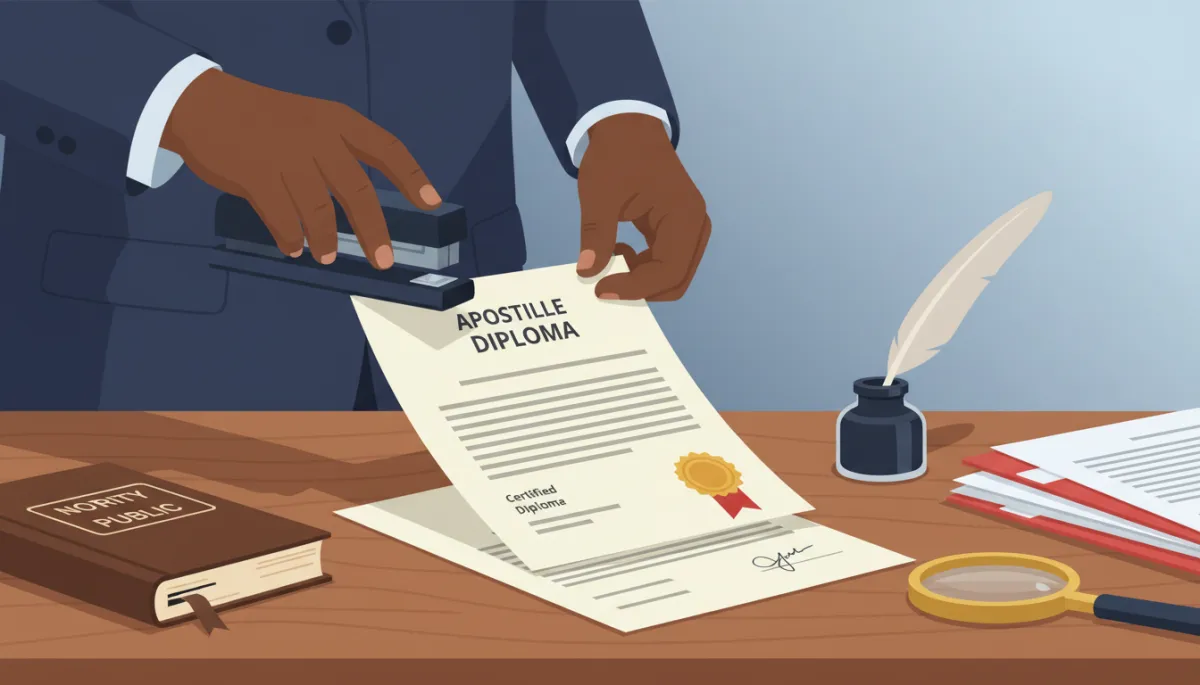
An apostille confirms your diploma’s authenticity so it can be trusted abroad.
Apostilles for Transcripts: Why They Matter and How to Obtain Them
While diplomas prove that you earned a degree, transcripts show the details: which courses you took, how many credits you completed, and your grades. Many foreign universities, credential evaluators, and licensing bodies care just as much—sometimes more—about your transcripts than your diploma. As an individual, you may be asked to provide apostilled transcripts when:
Transferring academic credits to a university in another country
Applying to professional programs that require proof of specific coursework
Undergoing a foreign credential evaluation for immigration or employment
Ordering Official Transcripts for Apostille
The first step is to order official transcripts from your college or university. Most institutions issue them in sealed envelopes with the registrar’s signature or stamp. When requesting transcripts for apostille, it helps to:
Mention that the transcripts are for international use and may need notarization or certification
Ask whether the registrar can have the transcripts notarized directly, which often simplifies the apostille process
Notarization and Certification of Transcripts
Many apostille authorities require that transcripts be either:
Signed by a registrar whose signature is already on file with them, or
Notarized by a notary public who certifies the registrar’s signature
As an individual, you may need to coordinate between your college and a notary. Some universities have an in-house notary who can handle this step. The apostille will then confirm that the registrar’s or notary’s signature is genuine, making your transcripts acceptable abroad.
Sending Transcripts for Apostille
Once your transcripts have the necessary signatures or notarization, you submit them to the apostille authority, just as you would with a diploma. Be sure to check:
Whether the transcripts must remain in a sealed envelope, or if they can be opened for notarization
How many apostilled copies you need, especially if you plan to apply to multiple institutions
📌 Key Takeaway: Diplomas prove that you graduated; transcripts show what you studied. Many international processes require apostilles on both, so plan ahead and request enough copies from your college.
Practical Tips for Individuals Handling Apostilles on Their Own
Managing apostilles for college diplomas and transcripts can feel overwhelming, especially if you are juggling applications, travel plans, or work commitments. These practical tips can help you stay organized and avoid common mistakes:
Start early. Processing times can stretch longer than expected, particularly during peak seasons for university admissions or immigration filings.
Check country requirements. Confirm that the country you are dealing with is part of the Hague Apostille Convention. If it is not, you may need a different legalization process involving consulates or embassies.
Ask about translations. Many institutions require certified translations of your diploma and transcripts after they have been apostilled. Find out whether translations must be done locally or in the destination country.
Keep digital and physical copies. Scan your apostilled documents and store them securely. Some institutions accept digital copies for initial review, even if they later need originals.
Consider a professional service if needed. If you are short on time or live far from your college or the apostille office, document services can manage the steps on your behalf for a fee.
Common Questions from Individuals About Apostilles for Education Documents
Do I Need an Apostille for Both My Diploma and My Transcripts?
That depends on what the foreign institution asks for. Some only request an apostilled diploma, while others insist on apostilled transcripts as well. When in doubt, it is wise to prepare both. Having apostilles on your diploma and transcripts offers flexibility if you decide later to apply elsewhere or change your plans.
Will an Apostille Expire?
The apostille itself does not usually expire, but some institutions only accept documents issued or apostilled within a certain time frame, such as the last six or twelve months. If your documents are several years old, you may be asked to obtain fresh copies and new apostilles, especially for transcripts that reflect your academic record at a specific point in time.
Can I Use the Same Apostilled Documents for Multiple Applications?
Yes, as long as you still have the original apostilled documents in your possession. However, some universities or agencies may keep the documents you submit and not return them. If you expect to apply to several places, order multiple certified copies of your diploma and transcripts, and consider having more than one set apostilled.
Bringing It All Together: Making Your Education Travel with You
Apostilles for college diplomas and transcripts may seem like just another layer of paperwork, but they serve a simple purpose: helping institutions in another country trust that your documents are real. As an individual, understanding the process empowers you to move more confidently toward your goals—whether that means studying in a new country, advancing your career, or starting a new life abroad.
By planning ahead, coordinating with your college, and following the steps required by your local apostille authority, you can ensure that both your diploma and transcripts are properly authenticated. Once that is done, your hard-earned education is no longer limited by borders—it becomes a credential you can carry with you, wherever your next opportunity appears.